What a Solar Kit Doesn't Include: The Hidden Costs Nobody Mentions
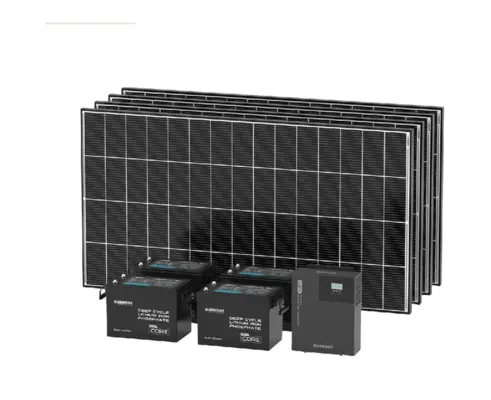
Solar panel kits are marketed as complete systems — and the panels, charge controller, and wiring that ship in the box are real, functional components. But a kit alone does not produce usable power. The components it leaves out — battery, inverter, cables, fusing, mounting, permits, and tools — can easily cost as much as the kit itself. This guide covers every hidden cost so you can budget accurately before buying.
Battery Storage
No standard solar panel kit includes a battery. Without battery storage, your system only produces power while the sun is shining — useless for nighttime loads, evening use, or cloudy-day reserves. A quality LiFePO4 battery adds $200–$600 for a 12V 100–200Ah unit suitable for small systems, or $600–$1,500 for a 48V 100Ah rack-mount battery for whole-home builds. Budget for battery storage as a non-negotiable cost alongside the kit itself.
Inverter
If you need AC power (standard 120V outlets for household appliances), you need an inverter. A 1,000W pure sine wave inverter costs $80–$200. A 3,000W unit for larger loads runs $200–$500. A hybrid inverter-charger for whole-home backup costs $1,500–$5,000. The kit's charge controller manages panel-to-battery charging, but it does not convert DC battery power to AC for your appliances.
Heavy-Gauge Cables and Fusing
Kits typically include panel-to-controller wiring (usually 10–12 AWG with MC4 connectors). What they omit is the heavier gauge cable needed between the charge controller and battery bank (often 6–2 AWG depending on current), battery-to-inverter cables (often 2–2/0 AWG for high-current inverter connections), inline fuses and fuse holders for battery protection, a DC disconnect switch for safe maintenance, and a battery monitor or shunt for state-of-charge tracking. Budget $50–$200 for cables, fuses, and disconnects depending on system size.
Mounting and Racking
Some kits include basic Z-brackets for mounting panels to a flat surface. Very few include a complete racking system suitable for roof or ground mounting with proper waterproofing and structural engineering. A roof-mount rail system (IronRidge or Unirac) costs $200–$600 depending on the number of panels. A DIY ground mount from Unistrut costs $200–$500. Professional racking systems cost more but meet code requirements in jurisdictions that require engineered mounting.
Permits and Inspections
Grid-tied solar installations require an electrical permit in most jurisdictions — typically $100–$500 depending on your municipality. Off-grid systems on rural properties may require no permits, but verify with your local AHJ before assuming. Permit applications require a site plan, single-line electrical diagram, and equipment specification sheets. Some solar retailers provide pre-made permit packages for their hardware, simplifying this process significantly.
Tools and Miscellaneous
A basic solar installation requires a drill with appropriate bits (lag bolts into rafters for roof mounts, concrete anchors for ground mounts), a wire stripper and crimper for MC4 connector assembly, a multimeter for verifying voltage and continuity, conduit and conduit fittings for outdoor wire runs (required by code for most permanent installations), cable ties, wire management clips, and weatherproof junction boxes. If you already own basic power tools, budget $50–$100 for solar-specific items. Starting from scratch, budget $150–$300.
The Real Total Cost
A $500 solar kit becomes a $1,200–$2,000 functional system once you add a battery, inverter, cables, fusing, and mounting hardware. A $1,500 kit for a larger system becomes $3,000–$5,000 complete. These are not criticisms of kit pricing — kits deliver genuine value by pre-matching panel and controller specifications — but the advertised kit price is not the total project cost. Budget for the complete system from the start to avoid the frustrating experience of having panels on your roof and no way to use the power they produce.
For battery options, see our best LiFePO4 batteries guide. For inverter selection, check our best pure sine wave inverters. For budget kit recommendations, see our best budget kits under $700.
A Complete Budget Example
Here is what a real 400W off-grid system costs when you account for everything beyond the kit price:
| Component | Estimated Cost |
|---|---|
| 400W Solar Kit (panels + 30A MPPT + wiring + brackets) | $450–$650 |
| LiFePO4 Battery (12V 200Ah) | $350–$500 |
| Pure Sine Wave Inverter (2,000W) | $150–$300 |
| Heavy-gauge cables + inline fuses | $40–$80 |
| DC disconnect switch | $30–$60 |
| Battery monitor (optional but recommended) | $50–$100 |
| Mounting hardware (if kit brackets insufficient) | $100–$300 |
| Miscellaneous (conduit, ties, junction box) | $30–$60 |
| Total System Cost | $1,200–$2,050 |
The kit itself represents roughly 30–55% of the total system cost. This is not a criticism — the kit provides the most technically complex component matching (panel-to-controller compatibility) and saves you significant research time. But knowing the real total cost from the start prevents the frustrating experience of ordering a kit and realizing you need another $500+ in components before it produces usable power.
For systems larger than 400W, the additional component costs scale proportionally. A 1,000W system needs a larger battery bank, a bigger inverter, heavier cables, and potentially a more robust mounting system. The kit-to-total-cost ratio remains roughly the same: the kit is 30–50% of the complete system.
Frequently Asked Questions
What does a solar kit not include?
Most solar kits include panels, a charge controller, panel wiring, and basic mounting brackets. They typically do not include a battery for energy storage, an inverter for AC power, heavy-gauge cables between controller/battery/inverter, a DC disconnect, fuses, a complete racking system, or permits. These additional components can cost as much as the kit itself.
How much extra do I need to budget beyond the kit price?
Budget for 1.5–3x the kit price as your total project cost. A $500 kit typically requires $700–$1,500 in additional components. A $1,500 kit requires $1,500–$3,500 more. The biggest costs are battery storage and the inverter.
Do I need a permit for a solar panel kit?
Grid-tied installations require electrical permits in most jurisdictions. Off-grid systems on rural properties may be exempt. Permit costs range from $100–$500 and require a site plan, electrical diagram, and equipment specifications. Always check with your local Authority Having Jurisdiction before installing.
The Professional Installation Alternative
If the list of hidden costs feels overwhelming, professional installation eliminates the guesswork — but at a significant price premium. Professional installers handle all components, permitting, inspections, and utility interconnection as part of their quoted price. Typical professional residential solar installation costs $2.50–$4.50 per watt fully installed, compared to $1.00–$2.00 per watt for DIY-sourced components. On a 6 kW system, that is a difference of $9,000–$15,000 in labor and markup. The DIY path requires more upfront research, careful planning, and hands-on work, but the financial savings are substantial — particularly now that the 30% federal tax credit no longer reduces the cost of professional installation.
A middle-ground option: purchase all components yourself (capturing the significant retail pricing advantage over installer-marked-up equipment) and hire a licensed electrician for the final connections, grounding, and panel termination only. This typically costs $500–$1,500 in electrician labor and gives you code-compliant connections and inspection-ready workmanship without the full professional installer markup on every component.
Affiliate Disclosure: SolarPanelKits.co is a participant in the Amazon Services LLC Associates Program and eBay Partner Network. We earn commissions from qualifying purchases at no extra cost to you. All recommendations are based on genuine research — we never fabricate reviews or ratings.