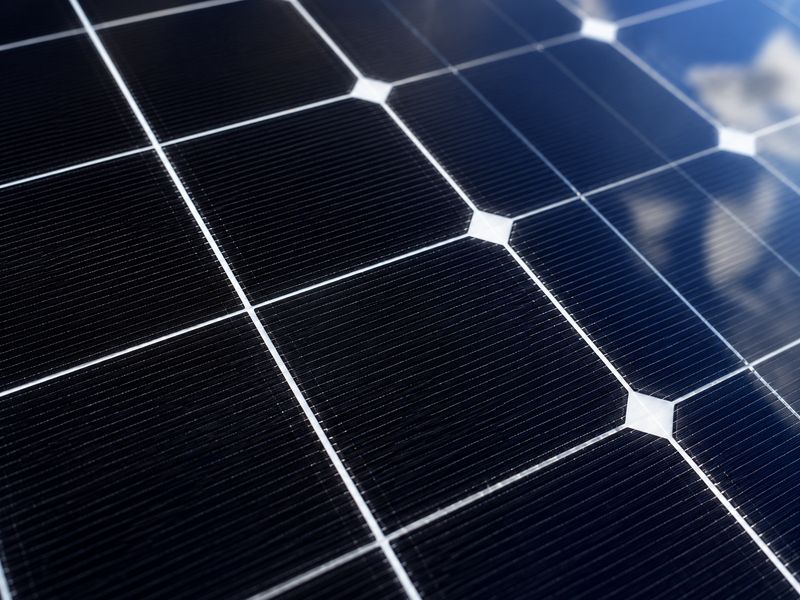
Rigid monocrystalline panels are the backbone of any permanent solar installation. Higher efficiency per square foot, longer warranties, and proven durability through decades of real-world use.
Rigid panels are the right call whenever a system is staying put — roof-mounted on a cabin or home, bolted to a ground-mount frame, or permanently wired into an off-grid build. Compared to portable and folding panels, rigid monocrystalline units deliver more watts per square foot, hold up better to weather over a 20–25 year lifespan, and mount with standard rails, clamps, and Z-brackets rather than needing to be set up and packed away each use.
Monocrystalline panels use single-crystal silicon cells and typically run 20–23% efficient, with a uniform black appearance. Polycrystalline panels use multiple silicon fragments melted together — slightly lower efficiency (15–17%) but noticeably cheaper per watt. For roof space that's limited, monocrystalline gets you more output per panel. For ground-mount builds where space isn't the constraint, polycrystalline can be the better value.
Individual rigid panels make sense when you're sizing a system to an exact roof layout, mixing brands, or already own a charge controller, battery bank, or inverter and just need panels. If you're starting from zero, a complete kit with matched components is usually the faster, lower-risk path.
Six panels spanning 100W budget options to 550W commercial-grade output.
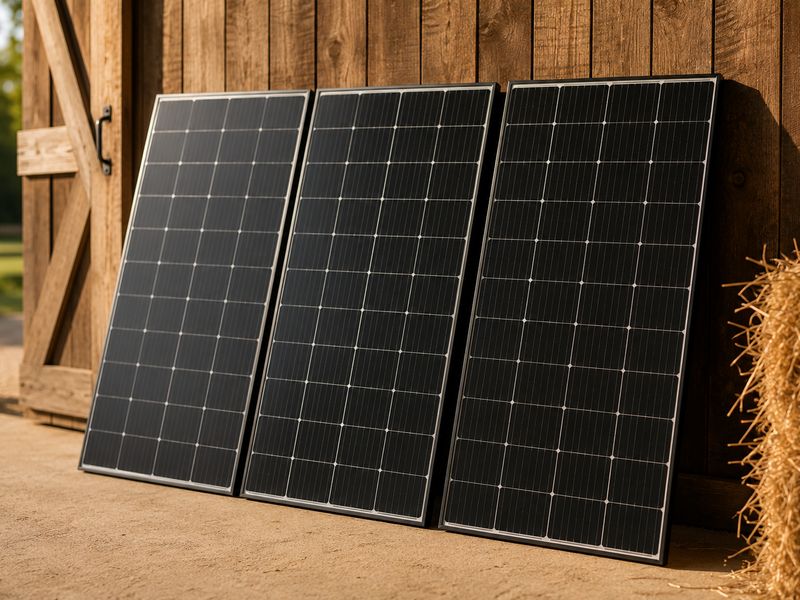
Workhorse 100W panel with corrosion-resistant aluminum frame and pre-drilled mounting holes. The most popular off-grid panel on the market.
Half-cut cell technology for better shade tolerance. 200W in a compact frame with reinforced glass.
Residential-grade 400W panel with split-cell technology. Industry-leading 25-year warranty.
Commercial-grade high-output panel. PERC+ cell technology at 22.3% efficiency. Ideal for large off-grid arrays.
Budget-friendly poly panel for basic setups. Slightly lower efficiency but significantly cheaper per watt.
High-density residential panel with 210mm cells. Excellent low-light performance.
Divide your daily watt-hour requirement by your average peak sun hours (typically 4–6 depending on location and season), then divide by panel wattage. Our System Sizing Guide handles the full calculation, including battery and inverter sizing.
You can, but panels wired in series should match voltage, and panels wired in parallel should match current output — otherwise the array performs at the level of its weakest panel. Sticking to matched panels per string avoids this entirely.
If you're building a custom layout or already own some components, individual panels give you control. If you're starting from zero, a complete kit removes the guesswork of matching a controller, battery, and inverter to your panels.